70% of New CEOs Fail
Sources: Gartner · Heidrick & Struggles · Stanford Rock Centre · The Conference Board · Institute of Executive Development
I help you join the 30% who succeed
Working with new CEOs and Business Heads navigating the transition that derails most leaders - not through lack of capability, but through the shift in role, complexity and system-level leadership.
Arrange a conversation
Executive Coaching Singapore | CEO & Leadership Team Development
MCC Master Certified Coach · BCC Board Certified Coach · 25,000+ Coaching Hours · Coaching Practice Est. 2001
Delivering systemic corporate leadership development and executive coaching for MNC regional headquarters in Singapore and globally, including: SAP · Nokia · SimCorp · BNP Paribas · Société Generale · American Express · FedEx · Maersk · Disney · Olam International · Coats Plc · Avaya · Akzo Nobel · Siemens · Bank of Singapore · ING · TMB · DiGi · Clariant · DSM-Firmenich · Total · among others
Trusted Executive Coach for Singapore Public Sector Leaders, Ministries, and Statutory Boards, including: EDB · Monetary Authority of Singapore · Prime Minister's Office · A*STAR · GovTech · SGInnovate · Design Singapore · SIT Singapore Institute of Technology
Who this is for
If you are a newly appointed CEO or Business Head — or about to become one
You are stepping into the biggest role of your career. The capability that got you here is not in question. What changes now is everything else — the scope, the complexity, the expectations, the pace.
And there is something nobody tells you before you get there. You can't show uncertainty to the people above you. You can't show it to the people beneath you. For the first time in your career, there is nobody to think things through with openly and honestly — without consequence.
Most leaders who struggle in the first two years do not fail because they lack talent. They fail because they are navigating the hardest transition of their career completely alone. That is where I come in.
When I get involved
People come to me at four different points in that journey.
Before you start. The promotion is confirmed. You have a few months before you step in. We use that window deliberately — so that when you walk in on day one, you are already thinking and operating like the leader this role needs, not the one you were in your last job.
On day one. Sometimes things move a little faster. You start the role and within days the scale of what you have taken on is clear. You realise you need support from the beginning rather than waiting until the cracks appear. You typically have a window of three months before anyone starts to look and ask "Did we get that right?" So I have a structured approach to get you up to speed.
Six to nine months in. You are in the role. Reality has set in. It is more complex, more demanding, and lonelier than you expected. You need help now — and you are right to ask for it.
Going into year three. The most common scenario. Year one: you took your time, looked around, decided what needed to change. Year two: you tried to implement it — and hit resistance. What you did not realise is that twelve months of careful observation taught everyone around you that nothing was actually going to change. Now you need year three to be different. This is where you need some very practical approaches to overcome obstacles and get the organisation lined up behind you. Rapid change is required.
If you are the CHRO or HR Director
Your most senior appointments carry the most risk. A leadership transition that goes wrong is expensive, disruptive, and visible at board level. When you look at the recruitments cost for this level, you can provide a full business cycle of coaching to ensure the success of the appointment for less than 50% of that.
Tony works with a small number of organisations to provide executive coaching for their most critical senior appointments — newly appointed CEOs and Business Heads stepping into full P&L responsibility for the first time.
In either case — the next step is a conversation.
Arrange a conversationWhat the work can look like
Every engagement starts with the CEO. From there, the work can extend into the organisation at whatever depth the situation requires; sometimes CEO 1:1 is all that is needed, and sometimes more is called for. The CEO work can also dovetail with the implementation of internal leadership development you do in-house.
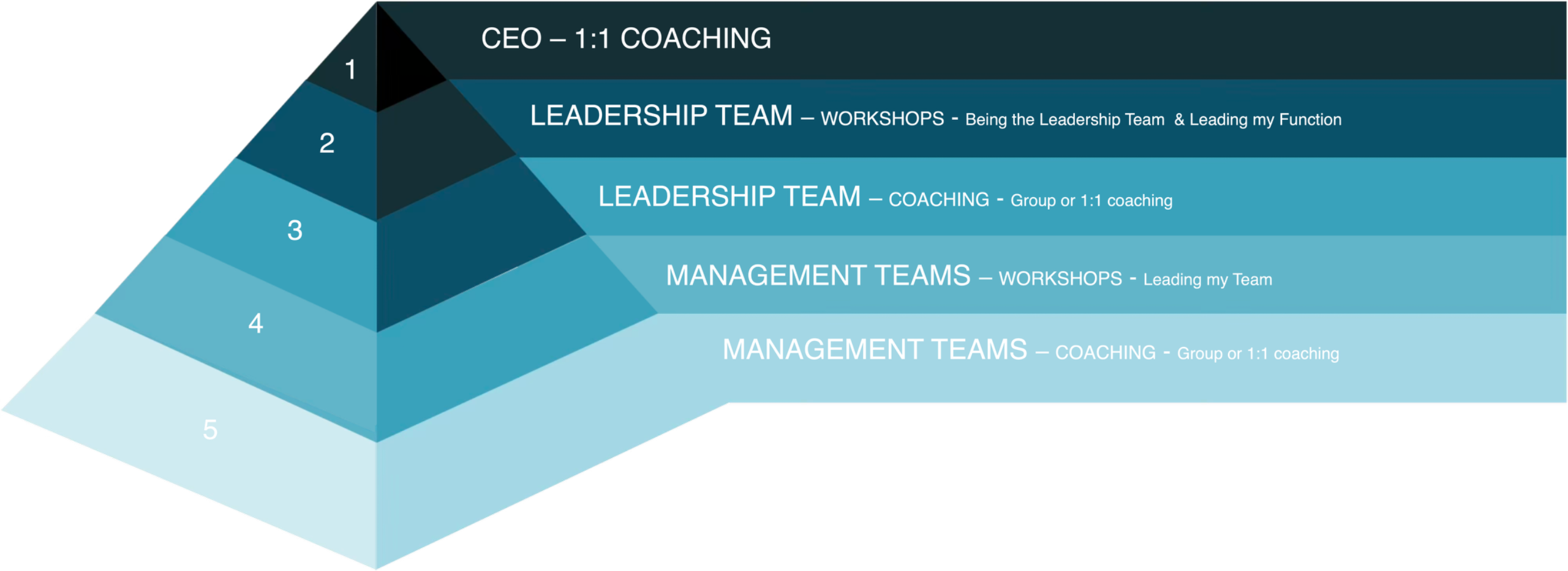
Level 1 — CEO: 1:1 Coaching
Individual coaching through the transition and into the first full business cycle, at whatever frequency the situation requires.
Find out more about Executive Coaching →
Level 2 — Leadership Team: Workshops
Two structured workshops that take the leadership team from a group of functional leaders to the team that runs the business.
Find out more about Leadership Team workshops →
Level 3 — Leadership Team: Coaching
Group and individual coaching to embed the changes the workshops started and keep the team moving forward.
Find out more about Leadership Team coaching →
Level 4 — Management Teams: Workshops
Leadership skills development for all people managers, delivered as workshops or as a Leadership at the Speed of Thought™ masterclass.
Find out more about Management Team workshops →
Level 5 — Management Teams: Coaching
Group and individual coaching to put the workshop learning into practice. For ongoing flexible support, Coaching as a Service (CaaS) is the right conversation.
CEO Transition Case Studies
Proven outcomes: newly appointed CEOs and business heads, across APAC and Europe
- A COO moved up two levels to Regional President in a lagging business. The turnaround was delivered, and she was later promoted to be the first woman on the global board.
- Coaching a leader into his first top job as Regional CEO, then transforming his direct reports into "the team that runs the business", and finally into a global role.
- A General Manager stepped up to Regional CEO. By the close of the engagement the organisation had a common language of leadership operating at every level of management.
Ready to talk?
Every engagement starts the same way — with a straight conversation about where you are, what you are dealing with, and what success needs to look like.
From there, based on 25 years of working with leaders at this level, I will give you a direct view on what the work should involve and how we structure it together.
Arrange a conversation