70% of New CEOs Fail

Source: Gartner · Heidrick & Struggles · Stanford Rock Centre · The Conference Board · Institute of Executive Development

I help you join the 30% who succeed

Executive Coaching

Arrange a conversation
MCC Master Certified Coach · BCC Board Certified Coach · 25,000+ Coaching Hours · Coaching Practice Est. 2001

Private Sector: SAP · Nokia · SimCorp · BNP Paribas · Société Generale · American Express · FedEx · Maersk · Disney · Olam International · Coats Plc · Avaya · Akzo Nobel · Siemens · Bank of Singapore · ING · TMB · DiGi · Clariant · DSM-Firmenich · Total · among others

Public Sector: EDB · Monetary Authority of Singapore · Prime Minister's Office · A*STAR · GovTech · SGInnovate · Design Singapore

The transition that derails most new CEOs

Every year, 15% of general management roles globally need to be filled. 76% of companies do not have a ready successor in place, so they either promote someone who is not quite ready, or hire from outside. The result: 70% of new CEO appointments fail to meet performance expectations within the first eighteen months.

The research is consistent across major leadership institutions.*

And the research also tells us why.

It is not capability. The people being appointed to these roles are experienced, intelligent, and proven. They have earned the position.

Only 7% of companies formally assign a coach or mentor to their most senior appointments.
So 93% of newly appointed CEOs navigate the hardest transition of their career without structured support.

What nobody told you is what you are actually walking into.

Your leadership team is watching and waiting to see what changes. They are often not a leadership team at all; they are a group of functional heads. Every cross-functional conversation escalates to you, making it impossible to find the time for strategic thinking when you are constantly being pulled into the operational detail.

At the same time, the Board expects a strategy; the Business expects results; the Organisation expects stability. All three, simultaneously, while you are still learning what you have actually inherited.

And there is nobody to think any of this through with, openly and honestly, without consequence.

That is where I come in.

* Source: Gartner · Heidrick & Struggles · Stanford Rock Centre · The Conference Board · Institute of Executive Development

How the work happens

Every engagement starts with the CEO. That is always the entry point. From there, the work can extend into the organisation at whatever depth is needed, from the leadership team all the way through the management population.

Not every engagement covers all five levels. The scope is always determined by what the organisation actually needs.
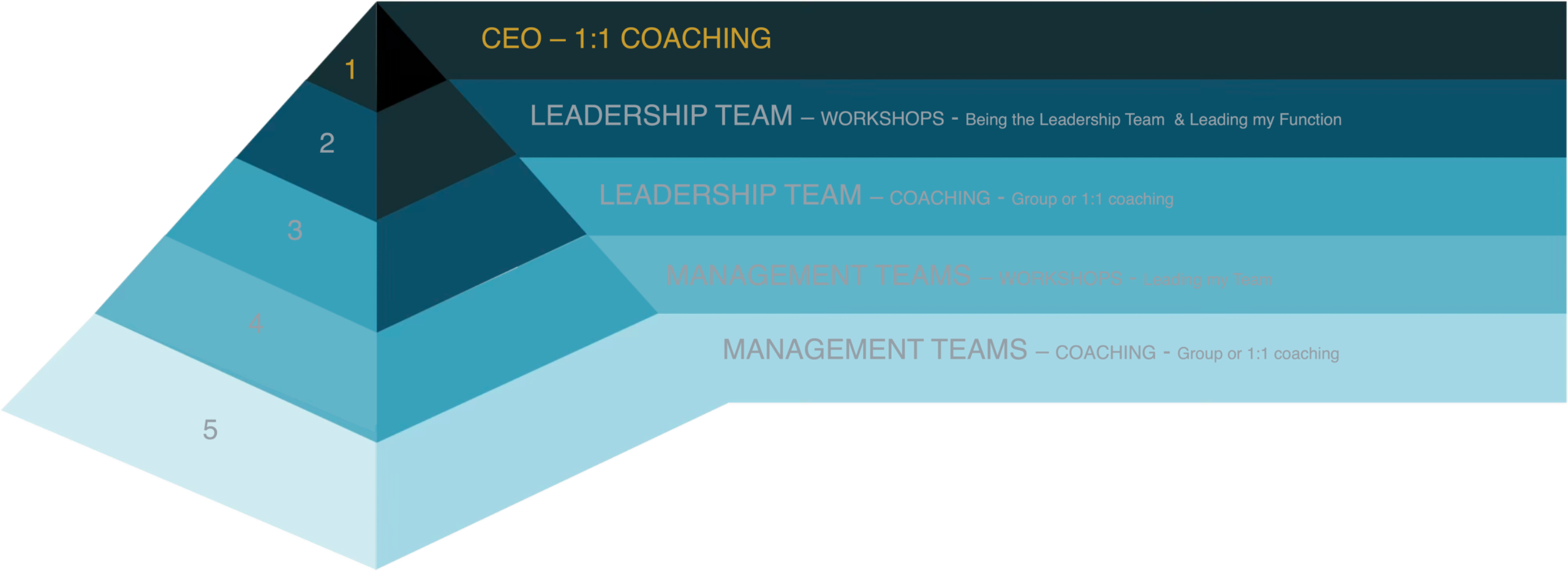
Level 1 — CEO: one to one coaching

The engagement begins with a structured kick-off, establishing clearly why we are doing this, what success looks like, and how I will know when we have achieved it.

From there I conduct stakeholder mapping: identifying the key relationships the new CEO needs to build, manage and develop. I run stakeholder interviews to gather real behavioural feedback, specific, factual, and actionable. And I teach the CEO how to work with their stakeholders on an ongoing basis, so that behavioural change is visible, recognised and sustained.

I work with CEOs on either an annual or quarterly basis, depending on the situation. Where a CEO is operating across multiple geographies and needs me on site at overseas locations for shadow coaching, I take on annual engagements, a full twelve-month commitment through a complete business cycle. Because of the travel commitment this involves, I work with a maximum of three CEOs at this level at any one time. Where the CEO is Singapore-based or does not require overseas shadow coaching, a quarterly engagement is the right structure, starting with a minimum of two quarters and extending as needed. All engagements are supported by TonyLatimer.ai, your 24/7 leadership development companion that speaks your language, giving you on-demand access to leadership learning and support between sessions.

Level 2 — Leadership Team: workshops

Two workshops, each addressing a distinct challenge.

The first, Being the Leadership Team, focuses on how the team operates together. Research shows that a group of people working together will always come to a better solution than the smartest person in the room operating on their own.* (Robert Cialdini, summarising Laughlin et al.) Most leadership teams never fully leverage this. When a problem arises in one function, the functional head tries to solve it alone. This workshop changes that. The leadership team agrees how to work together and what group and individual behavioural change is required. They build their team charter and make the shift from a group of functional heads to the team that runs the business.

The second, Leading my Function, addresses a practical reality: everyone in the leadership team is already fully occupied. Nobody is sitting around with spare capacity. In order to spend more time operating as a leadership team, each member has to free up time from leading their function. This means developing their direct reports, building capability at the level below them so that work can be migrated down the organisation.

Find out more about the Leadership Team workshops →

Level 3 — Leadership Team: group coaching

This is a proprietary process I developed over 25 years of working with leadership teams. A structured one-hour, four-phase group coaching session in which the team coaches itself around a real business challenge brought by one member. Fast, efficient, and genuinely useful, it utilises coaching, mentoring and peer insight in a unique forum that most organisations do not have.

I lead sessions over a six to nine month period, and simultaneously teach the team to facilitate the process themselves, so they can continue independently long after the engagement ends. This is a capability build, not a dependency.

There will always be topics and areas of assistance that are inappropriate to be brought up in a group setting. To address that, individual coaching is available as a separate engagement.

Level 4 — Management Teams: workshops and on-demand learning
Leadership skills development for all people managers, delivered either as small group workshops or as a Leadership at the Speed of Thought™ masterclass, a focused three-hour session that can reach large numbers of managers in one go. One investment, organisation-wide impact. Alongside the workshops, managers have access to TonyLatimer.ai, your 24/7 leadership development companion that speaks your language. Built on the complete Profitable Leadership® content library, managers can explore leadership challenges, get practical insight, prepare for difficult conversations, and develop scripts for real situations they are facing, on demand, between sessions, whenever they need it.

Find out more about Management Team workshops →

Level 5 — Management Teams: group and individual coaching

Group coaching
Group coaching supports managers in implementing what they have learned from the workshops, embedding new behaviours and working through real challenges as they arise.

Individual coaching
For organisations that want ongoing, flexible individual coaching support without committing to a fixed programme, Coaching as a Service (CaaS) is the right conversation. A model that gives your senior leaders access to high-quality coaching exactly when they need it, without overcommitting on time or cost.

Find out more about Coaching as a Service (CaaS) →

* Laughlin et al., 2006. Summarised in Robert Cialdini, Yes!

How this works in practice

Global Software Company · European Headquarters

Regional CEO to Global CRO · APAC & Europe

A European software company operating globally through three Regional CEOs, each running self-contained commercial operations with matrix reporting to European headquarters. The candidate was hired externally to take over the APAC region and prepare it for significant planned growth over five years. The stated intention from the outset was that he would establish himself in the regional role and then move to a global position within two years.

The engagement covered three phases and three levels of the organisation simultaneously.

At the individual level: Phase one, coached into his first CEO role as Regional CEO of APAC, establishing his leadership approach and authority in a new organisation. Phase three, coached through the transition from Regional CEO to his first global role.

At the leadership team level: Phase two, the leadership team went through a structured workshop programme to transition from a group of functional leaders into the team that runs the business. The focus of the coaching at this phase was on developing the CEO's own capability to coach the leadership team, building internal coaching skill and self-sufficiency rather than dependency on external support.

Outcome: Leadership team fully transformed and operating with complete day-to-day ownership of the business, enabling the candidate to allocate time to global strategy in preparation for the next role. Subsequently appointed Global Chief Revenue Officer. Tony coached him into the global role and coached in his successor as Regional CEO.


Global Flavour & Fragrance Company · Asia Headquarters

General Manager to Regional CEO · Singapore

A flavour and fragrance company operating across 27 countries in a global matrix structure. The Singapore operation serves as the regional hub combining manufacturing, sales, distribution, and creative application across Southeast Asia, Australia and New Zealand.

The candidate was selected as successor to a long-serving Regional CEO who had become the figurehead of the entire operation. The transition challenge was threefold: stepping into very established shoes, gaining the confidence and support of peers who were now becoming subordinates, and demonstrating to regional headquarters the executive presence and strategic capability expected at this level.

The engagement ran over twelve months, a full business cycle, covering three levels of the organisation simultaneously.

At the individual level: One to one coaching through the full transition, from preparation through the first complete business cycle.

At the leadership team level: Leadership training to develop how they led the managers beneath them, combined with both group and individual coaching to embed the change and support the team through the transition in leadership.

At the management level: Leadership training rolled out across all people managers in the organisation, with a specific focus on enhancing performance management capabilities, supported by group coaching follow-up to embed implementation.

Outcome: All transition challenges successfully overcome. By the end of the engagement the organisation had a common language of leadership operating at every level of management, from the Regional CEO down through the full management population, with measurably stronger performance management capability across the organisation.

Every engagement starts the same way.

It starts with a conversation. We discuss where you are, where you need to be, and what needs to be done differently in order to get there. Everything else follows from that.