70% of New CEOs Fail
Source: Gartner · Heidrick & Struggles · Stanford Rock Centre · The Conference Board · Institute of Executive Development
I help you join the 30% who succeed
Leadership Teams
Arrange a conversation
MCC Master Certified Coach · BCC Board Certified Coach · 25,000+ Coaching Hours · Coaching Practice Est. 2001
Delivering systemic corporate leadership development and executive coaching for MNC regional headquarters in Singapore and globally, including: SAP · Nokia · SimCorp · BNP Paribas · Société Generale · American Express · FedEx · Maersk · Disney · Olam International · Coats Plc · Avaya · Akzo Nobel · Siemens · Bank of Singapore · ING · TMB · DiGi · Clariant · DSM-Firmenich · Total · among others
Trusted Executive Coach for Singapore Public Sector Leaders, Ministries, and Statutory Boards, including: EDB · Monetary Authority of Singapore · Prime Minister's Office · A*STAR · GovTech · SGInnovate · Design Singapore
When the leadership team is the problem
A new CEO inherits a leadership team. In most cases, what they actually inherit is a group of functional heads who have learned to operate independently, escalate decisions upward, and protect their own territory. That is not a leadership team. That is a collection of individuals who happen to report to the same person.
Getting that group to operate as the team that runs the business is one of the most consequential things a new CEO can do. It is also one of the hardest, because the people involved are senior, experienced, and often convinced they are already doing it.
This is where I come in; delivering systemic leadership team coaching and high-impact corporate programs designed for complex multinational corporate structures across Singapore and the APAC region.
What the work involves
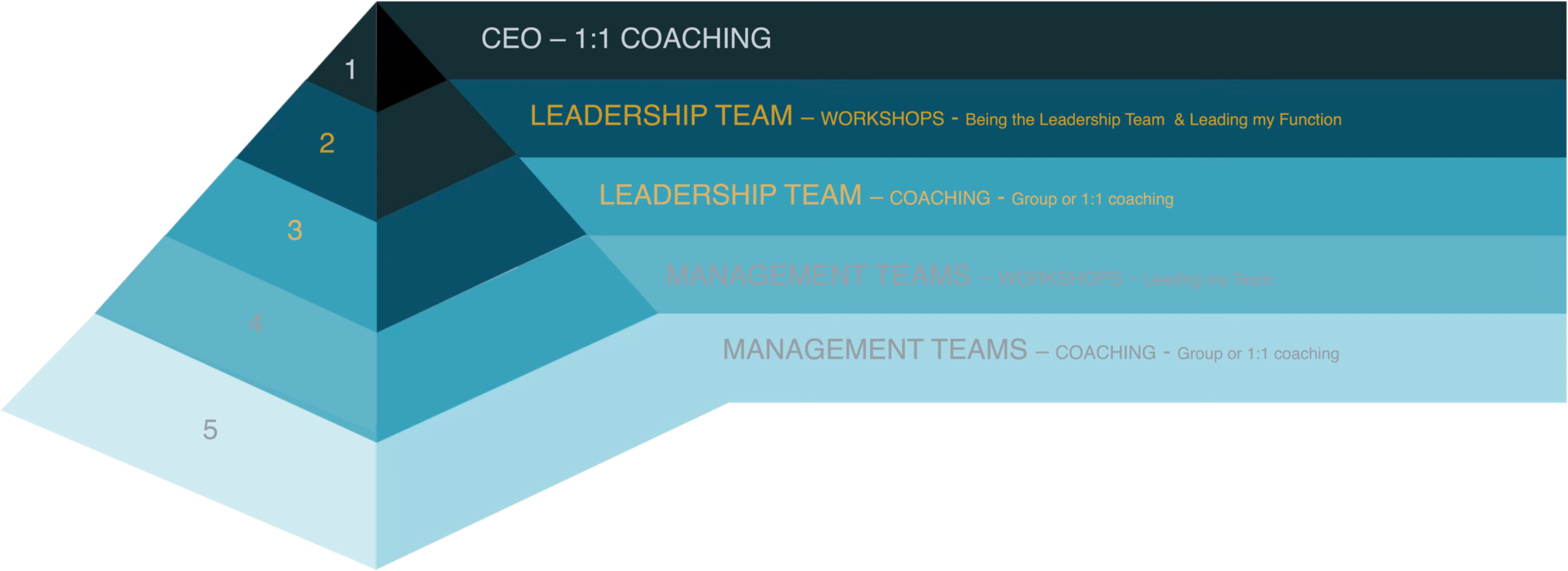
Level 2 — Leadership Team: workshops
Two workshops, each addressing a distinct challenge.
Workshop 1 — Being the Leadership Team: Strategic Leadership Team Training & Alignment - is a workshop that addresses how the team operates together. Research shows that a group of people working together will always arrive at a better solution than the smartest person in the room working alone.* Most leadership teams never fully leverage this. When a problem arises in one function, the functional head tries to solve it alone. This workshop changes that. The team agrees how to work together, what group and individual behavioural change is required, and builds the charter that makes the shift from a group of functional heads to the team that runs the business. Which frees you up to be the strategic leader the business needs.
Workshop 2 — Leading my Function: Scalable Leadership Team Training - addresses a practical reality; every member of the leadership team is already fully occupied. Nobody has spare capacity. In order to spend more time operating as a leadership team, each member has to free up time from leading their function. That means developing their direct reports and building the capability at the level below them, so that work can be migrated down the organisation.
Level 3 — Leadership Team: coaching
Three forms of coaching, addressing three different kinds of problem.
Group coaching — Leadership Team Coaching: the Systemic Leadership Team Coaching Framework - a proprietary process I developed over 25 years of working with leadership teams. A structured one-hour, four-phase group coaching session in which the team coaches itself around a real business challenge brought by one member. Fast, efficient, and genuinely useful; it combines coaching, mentoring and peer insight in a forum that most organisations do not have. I lead sessions over a six to nine month period and simultaneously teach the team to facilitate the process themselves, so they can continue independently long after the engagement ends. This is a capability build, not a dependency.
Individual coaching — Coaching as a Service (CaaS): senior coaching on demand - an annual plan that gives your leadership team access to coaching at the point they need it. Each month your organisation receives an allocation of coaching hours, distributed across the team and directed to whoever needs them most. When a leader has something to work on, they book directly with me for a focused engagement on that specific issue, with no minimum programme length and no fixed structure.
Find out more about Coaching as a Service (CaaS) →
Individual coaching — Senior Executive Transition Coaching: a full programme for one leader - for a member of your leadership team stepping into a larger role, or already in one and finding that it demands something different. It runs quarterly, starting with a minimum of two quarters, and includes planned coaching, shadow coaching, stakeholder interviews at the outset and calibration throughout. It is scoped with you and the individual, and opens with a three-way kick-off session so that all parties are aligned on the purpose and the intended outcome. Where a promotion has not yet delivered what was expected, this is the work that brings it back on track.
* Laughlin et al., 2006. Summarised in Robert Cialdini, Yes!
These engagements are designed to work alongside CEO coaching, but they can also be commissioned independently by a CHRO or HR Director where the need is clear.
If your organisation also needs leadership development at the management level, that work sits one level down.
Leadership Coaching Case Studies
Proven outcomes: leadership teams transformed alongside the chief executive, across APAC and Europe
- Coaching a leader into his first top job as Regional CEO, then transforming his direct reports into "the team that runs the business". By the close they had complete day-to-day ownership, and he moved up to a global role.
- A General Manager stepped up to Regional CEO across a full business cycle, with the leadership team trained and coached alongside him. The organisation finished with a common language of leadership at every level.
Every engagement starts the same way.
It starts with a conversation. We discuss where you are, where you need to be, and what needs to be done differently in order to get there. Everything else follows from that.