
The True Cost of Executive Hiring and CEO Failure
The True Cost of Executive Hiring and First-Time CEO Failure
The True Cost of Executive Hiring and First-Time CEO Failure: What Organisations Are Really Paying For
1. Introduction
Appointing a chief executive—particularly someone stepping into a general management role for the first time—is among the highest-stakes decisions an organisation makes. It is also among the most financially consequential, and not only in the obvious ways. The recruitment fee is visible. The severance payment, when things go wrong, is visible. What rarely gets tallied up are the layers beneath: the interim leadership costs, the repeat search, the key people who leave, the projects that stall, the revenue that does not materialise.
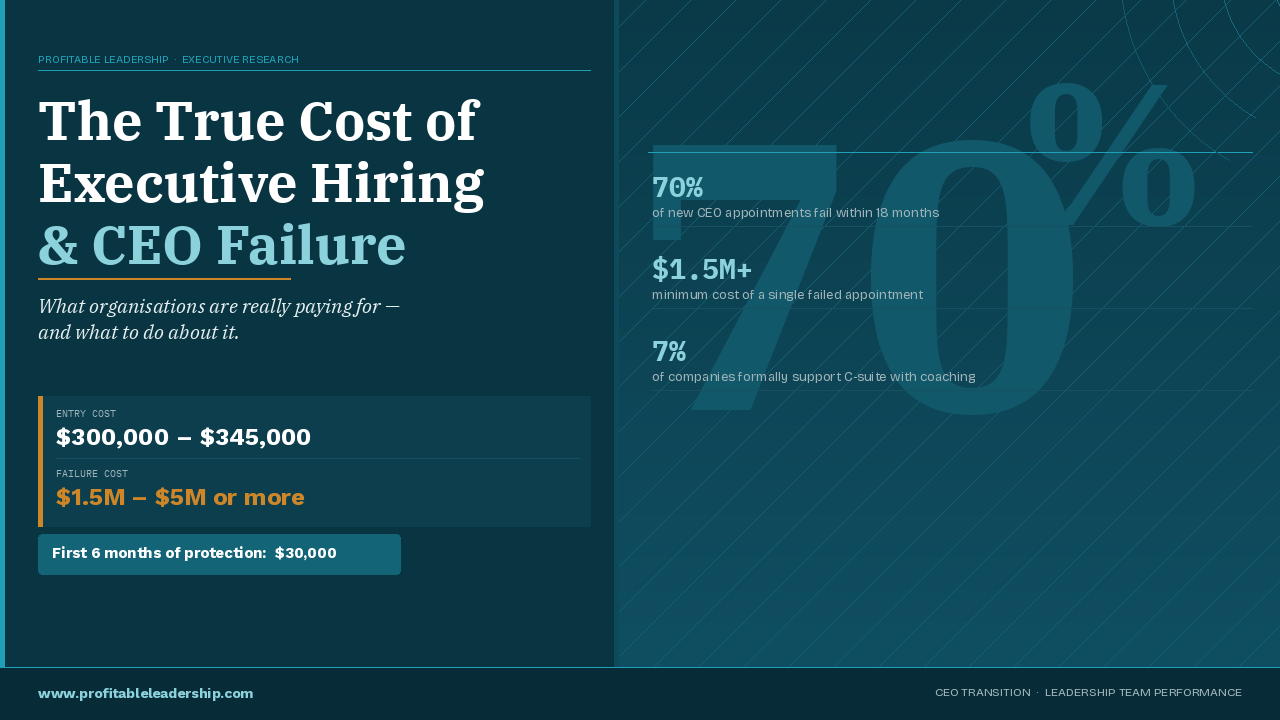
When those costs are aggregated, the failure of a single senior executive appointment can cost an organisation between SGD 1.5 million and SGD 5 million or more. For a CEO with a total compensation package of SGD 500,000, that represents a cost multiple of three to ten times salary—for one hire, in one appointment cycle. Set against numbers of that magnitude, the question of how to protect the investment becomes not a soft HR conversation but a hard commercial one.
This article addresses that question from two directions that are rarely considered in the same analysis. The first is the perspective of the organisation making the appointment: what it costs, what the failure data tells us, and what evidence-supported interventions most effectively reduce the risk. The second is a perspective that is well understood by experienced practitioners in the executive search and senior leadership community, but almost entirely absent from the formal literature: the perspective of the executive being appointed, and the contractual asymmetry that the failure data implies for how they should approach the two sides of their employment agreement. Both perspectives point toward the same conclusion—that the first year of a new CEO's tenure is where the decisive investment must be made, and that most organisations are not currently making it.
2. The Baseline Investment: What Recruitment Actually Costs
Recruitment fees are calculated as a percentage of the candidate's first-year total compensation—base salary plus target bonus—and that percentage rises sharply with seniority. This is partly because senior searches are more complex and partly because retained search firms, which handle the top of the market, operate on a fundamentally different commercial model to volume contingency agencies.
For first-level managers, the typical fee range sits at 15–25% of first-year salary (Eddy, 2026; CoreStaff SG, 2026). At Singapore's average manager salary of approximately SGD 58,000 (Indeed SG, 2026), this translates to a placement fee of SGD 8,700 to SGD 14,500—usually accompanied by a 90-day replacement guarantee (Glassdoor SG, 2026). At the senior manager level, fees move to 20–30% of total compensation (Glassdoor SG, 2026; CoreStaff SG, 2026), producing a fee range of SGD 14,500 to SGD 21,800 on average Singapore salaries of approximately SGD 72,500 (Indeed SG, 2026), with retained minimum fees reaching SGD 50,000 for more specialist briefs (TGS, 2026).
It is at the C-suite level that the numbers become genuinely significant. Global retained executive search firms charge 25–40% of first-year total compensation for senior leadership appointments (Hunter Recruiting, 2026; TGS, 2026; Pact & Partners, 2026; Chief Executive, 2026). In the Singapore market, multinational corporations using global retained firms typically operate at 30–35% (CoreStaff SG, 2026). For a representative Asia-Pacific Regional CEO on a total package of SGD 500,000—base salary SGD 350,000, plus bonus and equity—the initial recruitment fee alone reaches SGD 125,000 to SGD 175,000 (Hunter Recruiting, 2026; TGS, 2026).
That fee is typically structured in three tranches: one-third on engagement of the search firm, one-third on delivery of a shortlist, and one-third on the candidate's start date (Hunter Recruiting, 2026). To that, organisations must add relocation costs averaging SGD 50,000, sign-on bonuses commonly reaching SGD 100,000, and legal and onboarding administration of approximately SGD 20,000 (Aruba Executive, 2026). The total investment before the individual has led a single meeting can therefore reach SGD 295,000 to SGD 345,000.
3. The Negotiation Asymmetry: What Experienced Practitioners Know
As executives progress through the corporate hierarchy, they are typically guided—by mentors, by predecessors who have made similar moves, and by the retained search professionals who represent them—on how to negotiate the most advantageous appointment package. That guidance covers base salary benchmarking, bonus structure, equity participation, sign-on arrangements, and relocation provisions. It is well-established, widely shared within professional networks at senior levels, and forms a standard part of the informal preparation that distinguishes experienced executives from those making their first significant upward transition.
There is, however, a further piece of practitioner knowledge—less formally documented, shared selectively among those with direct experience of senior executive transitions—that the failure rate data in this article implicitly supports. It is this: when a CEO appointment is being negotiated, the executive should devote at least twice as much time, preparation, and professional attention to the terms of their severance agreement as they do to the terms of their onboarding package.
The logic is statistical rather than pessimistic. The onboarding package—the sign-on bonus, the relocation provision, the guaranteed first-year elements—is paid regardless of outcome. It is certain. The severance package, by contrast, is contingent on a departure event; it may never be triggered. But the data reviewed in this article establishes that 70% of new CEO appointments fail to meet performance expectations within the first 18 months (Profitable Leadership, 2026, citing Gartner; Heidrick & Struggles; Rock Centre at Stanford University; the Conference Board; and the Institute of Executive Development). In actuarial terms, the probability that the severance provisions of a new CEO's contract will be invoked within the first two years is substantially higher than the probability that they will not.
The practical implication for the executive is significant. Severance for a departing CEO typically runs to 12–24 months' base salary (Aruba Executive, 2026; Chief Executive, 2026), but the specific terms—the notice period, the basis on which termination is characterised, the treatment of unvested equity, the non-compete provisions, the conditions that trigger or exclude payment—are negotiable at the point of appointment and substantially more difficult to contest at the point of exit. Experienced practitioners in the executive search community are well aware of this asymmetry. It is less well understood by executives making their first appointment at this level, who tend to focus their negotiating energy on the certainties of joining rather than the contingencies of departure.
For the organisation, this dynamic creates a parallel consideration. The same failure rate data that argues for rigorous severance negotiation on the part of the executive argues, with equal force, for rigorous first-year support on the part of the organisation. The severance package is the financial instrument that manages the cost of failure after it has occurred. Executive coaching is the professional instrument that reduces the probability of the failure occurring in the first place. One is a mitigation of consequence; the other is a mitigation of cause. The data suggests that both deserve significantly more systematic attention than they currently receive.
4. The Hard Truths: Why So Many New CEOs Fail
Here is where the data gets uncomfortable. Every year, approximately 15% of general management roles globally need to be filled as incumbents retire, resign, fall sick, or are removed (Profitable Leadership, 2026, citing Gartner; Heidrick & Struggles; Rock Centre at Stanford University; the Conference Board; and the Institute of Executive Development). The term "general management" is used here in its broadest sense—it encompasses CEOs, Presidents, Business Unit Heads, Country Managers, and Regional Directors: any role defined by leading a group of functional leaders.
The succession pipeline available to fill these roles is, by any measure, inadequate. Research shows that 76% of companies do not have a ready-to-go successor in place when a senior role falls vacant (Profitable Leadership, 2026, citing Gartner et al.). Their choices are accordingly limited: promote an internal candidate who is not yet ready, or recruit from outside. Neither option removes the underlying transition risk. Both carry a significant probability of failure.
The consequences of this structural gap are stark. Seventy percent of new CEO appointments fail to meet performance expectations within the first 18 months (Profitable Leadership, 2026, citing Gartner; Heidrick & Struggles; Rock Centre at Stanford University; the Conference Board; and the Institute of Executive Development). This figure is consistent with broader industry data on short-tenure failure rates, which have increased by 79% year-on-year in recent periods (Aruba Executive, 2026). The pattern holds whether the appointment is an external hire or an internal promotion—the transition to general management is itself the risk event, and most organisations treat it as though it is not.
Understanding Why the Transition Fails
The failure is not random and it is not primarily a selection problem. It follows a pattern that is entirely predictable once the developmental arc of a leadership career is properly understood.
Profitable Leadership's framework identifies four distinct transitions in that arc: from individual contributor to leader of individuals; from leader of individuals to leader of leaders; from leader of leaders to functional head reporting to the CEO; and finally, to CEO or general management head (Profitable Leadership, 2026). Each transition carries its own risk profile. At each stage, individuals are typically advanced on the strength of their performance in the role they are leaving—the best technician becomes the technical manager, the best salesperson becomes the sales manager. The capabilities that earned the promotion are not the capabilities the new role demands.
By the time someone reaches the CEO transition, the accumulated risks of every prior transition are still in play. The new CEO has a leadership team reporting to them composed of functional heads. Those functional heads, however, are not a team in any meaningful sense—they are a group of individuals each managing their own domain. Anything that crosses functional boundaries, and most things of strategic consequence do, requires the CEO's direct involvement. Meanwhile, research indicates that 70–85% of leadership team members do not have a successor ready to step up if they were to leave unexpectedly (Profitable Leadership, 2026). The new CEO therefore inherits not merely a leadership challenge but a structural fragility running through the entire organisation beneath them.
The data on how time is spent at every management level reinforces this picture. Managers across all levels spend an average of 25% of their time firefighting problems escalated from below, and a further 12% engaged in persistent performance conversations that produce no durable resolution (Profitable Leadership, 2026). A typical leadership team member spends 90% of their time managing downward into their function and 10% reporting upwards, with very little time spent operating at the level of the business as a whole (Profitable Leadership, 2026). These patterns do not disappear when someone is promoted to CEO—they intensify, because the CEO inherits all of them simultaneously across every function in the organisation.
5. The 90-Day Window: A Critical Professional Observation
There is a practical dimension to all of this that the formal data does not fully capture. When a new CEO is appointed, recruitment agencies operating at the manager level typically offer a 90-day replacement guarantee (Glassdoor SG, 2026)—the period within which, if the placement fails, a replacement search is provided at no additional fee. That window is not arbitrary. It reflects a well-understood pattern: for the first 90 days, the organisation extends the benefit of the doubt. Performance scrutiny has not yet been applied with rigour. The onboarding narrative is still operative.
Around the 90-day mark, that changes materially. Boards begin forming assessments. Direct reports arrive at settled views. The informal networks within the organisation—which routinely exert more influence over day-to-day functioning than the formal hierarchy—have by this point reached a verdict about whether this individual has what the role requires. From that point forward, the new CEO is no longer being evaluated on potential; they are being evaluated on evidence.
This creates a non-negotiable priority for any properly designed first-year coaching intervention: the individual must be operating with demonstrable confidence and clarity at the level the role demands before that 90-day window closes. Not at full capacity—no individual steps into a first CEO appointment operating at maximum effectiveness from day one. But visibly and credibly in command of the role's fundamental demands, in a manner that generates the organisational trust needed to pursue the deeper work. The first 90 days are not a grace period to be waited out. They are the most consequential 90 days of a new CEO's tenure, and the period during which the trajectory of the entire appointment is effectively set.
6. The Direct and Indirect Costs of CEO Departure
When a CEO appointment fails and results in departure, the financial consequences cascade through the organisation in ways that are rarely captured in a single budget line. Available research estimates the total cost of a failed senior executive hire at between 200% and 400% of annual salary, with significant additional exposure in roles with direct revenue accountability (Horan Wealth, 2026; Aruba Executive, 2026; Chief Executive, 2026).
Direct costs are the most straightforward to calculate. Severance for a departing CEO typically runs to 12–24 months' base salary—SGD 350,000 to SGD 700,000—plus potential equity acceleration of SGD 100,000 or more (Aruba Executive, 2026; Chief Executive, 2026). Interim leadership during a replacement search costs approximately SGD 50,000 per month on a retained basis, adding SGD 150,000 to SGD 300,000 over a typical 3-to-6-month search period (Horan Wealth, 2026). A replacement search at the same seniority level then repeats the original search fee—SGD 125,000 to SGD 175,000—alongside onboarding costs of a further SGD 100,000 to SGD 200,000 for the incoming candidate (Aruba Executive, 2026). The direct cost subtotal for a failed appointment at this salary level sits at approximately SGD 750,000 to SGD 1,500,000.
Indirect costs are where the real exposure lies. Research estimates lost revenue for roles with direct P&L accountability at between five and twenty-seven times annual salary (Horan Wealth, 2026; Strategy+Business, 2026). For a CEO responsible for a SGD 100 million revenue target, even a modest growth deceleration during transition represents a material shortfall. Executive departures also reliably trigger secondary turnover: research estimates that 20–30% of direct reports leave within 12 months of a CEO transition (Horan Wealth, 2026; Aruba Executive, 2026). For a leadership team of five, replacement fees alone add SGD 100,000 to SGD 250,000. The ramp-up period for a successor CEO—averaging 9 to 12 months before full strategic effectiveness is established (Horan Wealth, 2026)—defers every strategic initiative in the queue. At the extreme end, the financial literature estimates shareholder value losses of up to USD 1.8 billion in unplanned executive turnover events (Strategy+Business, 2026).
| Cost Category | Estimated Range (SGD) | As % of Annual Salary |
|---|---|---|
| Initial + Re-Recruitment Fees | 250,000 – 350,000 | 50–70% |
| Severance and Interim Leadership | 500,000 – 1,000,000 | 100–200% |
| Team Turnover and Productivity Loss | 1,000,000 – 2,000,000 | 200–400% |
| Lost Revenue and Opportunity Cost | 1,000,000 – 3,000,000+ | 200–600%+ |
| Total Exposure | 1,500,000 – 5,000,000+ | 300–1,000% |
Sources: Hunter Recruiting (2026); TGS (2026); Horan Wealth (2026); Aruba Executive (2026); Chief Executive (2026); Strategy+Business (2026).
7. The Compounding Cost of the CEO Who Remains
The cost model presented in Section 6 addresses the scenario in which a failing CEO eventually departs. It is, however, incomplete. There is a second failure mode—less visible, less often modelled, and in many respects more consequential—that the standard financial analysis consistently overlooks: the CEO who underperforms and stays.
This scenario warrants specific analytical attention because it produces a materially different cost profile. The direct expenditures of exit—severance, interim leadership, replacement search, repeat onboarding—are not incurred. The organisation therefore does not register a discrete financial event against which it might measure loss. What it experiences instead is a slow, compounding erosion of the strategic and organisational value that the appointment was made to generate.
To understand why this matters, it is necessary to revisit the premise on which most senior CEO appointments are made. Organisations do not recruit a new chief executive because performance is satisfactory and continuity is the objective. They do so because something fundamental needs to change: a new market to be opened, a transformation programme to be executed, a business model to be restructured under competitive or technological pressure, or, critically, a cultural and behavioural environment that has become too rigid, too risk-averse, or too operationally inward-looking to sustain growth. The new CEO is selected specifically because those already inside the organisation are judged insufficiently positioned, or insufficiently independent of existing norms, to drive that change from within.
When a new CEO struggles in role but is not removed, the most significant cost is not the salary being paid to an underperforming executive. It is the strategic mandate going undelivered. Growth targets that were the rationale for the appointment are missed, not dramatically enough to compel a board response, but consistently enough to represent a material divergence from plan. Transformation programmes exist on paper and in communications but do not take root in the organisation's actual operating behaviours. The leadership team, which the CEO was expected to develop into a high-functioning collective, remains a group of functional heads operating in parallel rather than in concert.
What is particularly damaging about this scenario is the reinforcing dynamic it sets in motion at the level of organisational culture. Organisational norms—the embedded beliefs about how decisions are made, how problems are surfaced, how change is received, who speaks and who stays silent—are not static in the absence of active leadership. They are continuously being reinforced by the evidence of daily experience. Every month that passes without the promised change provides fresh data to the organisation's informal networks that the old ways are, in fact, the permanent ways. Every failed initiative, every strategy announcement that does not translate into observable behavioural change, every functional head who continues to operate in isolation rather than as part of a leadership team, deepens the organisation's implicit conviction that transformation is nominal rather than real.
The consequence is entrenchment: the specific cultural and operational patterns that the new CEO was appointed to displace become more deeply embedded precisely because the appointment appeared to represent change without actually delivering it. The organisation does not return to its prior state. It arrives at a state that is actively more resistant to future change than the one that preceded the appointment. The transformation window—which is always widest in the period immediately following a leadership transition, when the organisation is in a state of heightened receptivity to new direction—gradually closes. By the time the board concludes that the appointment has not delivered and a decision is finally made, the organisation is harder to change than it was before the CEO arrived.
The financial consequence of this entrenchment is not amenable to precise quantification in the way that severance or recruitment fees are. It manifests as market share not gained during a period when it was available, competitive positioning not established while a window remained open, organisational capability not built while the conditions for building it existed, and talent not retained because the promised environment of change failed to materialise. These are opportunity costs in the most literal sense—real in their magnitude, invisible in the accounts, and almost entirely absent from the frameworks that organisations use to evaluate executive performance risk.
Considered alongside the direct departure costs modelled in Section 6, the entrenchment cost of a CEO who underperforms and remains may, in organisations where the strategic mandate was significant, represent the larger loss. The exit costs are recoverable over time. The strategic windows that close while an underperforming CEO is retained are, in many cases, not.
8. Mitigation Strategies: Evidence and Cost-Effectiveness
The research literature identifies several evidence-supported approaches to reducing the probability of executive failure. Retained search firms offering 12-month replacement guarantees reduce re-recruitment cost exposure in early-failure scenarios (TGS, 2026). Objective-setting and contractual KPI alignment address the ambiguity that frequently underlies early CEO failure (Stone Talent Partners, 2026). Rigorous cultural fit assessment at the point of hire has been shown to reduce executive failure rates by up to 40% (Horan Wealth, 2026). Reactive departures—those driven by failure rather than planned succession—cost organisations an estimated 50% more than managed transitions (Strategy+Business, 2026), making the investment in succession planning infrastructure a measurable financial proposition.
Each of these approaches addresses, to varying degrees, the selection problem. What none of them addresses is the transition problem: the gap between a well-selected candidate and a successfully performing CEO. And it is the transition problem, not the selection problem, that the failure rate data most directly implicates.
Executive Coaching: The Most Cost-Effective Risk Mitigation Available
Against this backdrop, a single statistic demands attention: only 7% of companies formally assign a mentor or coach to their C-suite and senior executives for ongoing growth and development (Profitable Leadership, 2026, citing Rock Centre at Stanford University; the Conference Board; the Institute of Executive Development). Many organisations have leadership pipeline development policies on paper. Very few execute them at the critical moment—when a new general management appointment has just been made and the clock has started running.
The consequence is entirely predictable and entirely consistent with the failure rate data. New CEOs are navigating the most complex transition of their careers without structured support, while simultaneously being held accountable for delivering the strategic mandate for which they were appointed. The 70% failure rate is not an anomaly. It is the natural output of a system in which the investment in finding the right person is substantial, and the investment in helping them succeed is, in the overwhelming majority of cases, negligible.
Profitable Leadership (www.profitableleadership.com) addresses this structural gap through a five-level intervention model that operates across the full organisational system through which a new CEO must perform: 1:1 coaching with the CEO; leadership team workshops addressing both functional leadership and team cohesion; group or 1:1 coaching for the leadership team; management team workshops; and group or 1:1 coaching for management teams. This architecture is significant because it reflects an accurate understanding of where CEO failure actually originates. A new CEO's success is not determined solely by their own capabilities—it is directly shaped by whether the leadership team beneath them functions as a genuine collective or as a set of independent functional operators. The two must be developed in parallel, from the outset.
The CEO 1:1 coaching engagement—covering organisational purpose definition and communication, personal leadership time reallocation, building the leadership team as a functioning unit, and driving organisational change—is available at approximately (SGD) $60,000 for the first full year in role.
Considered against the risk profile documented in this article, the investment logic is direct. An organisation that has committed SGD 295,000 to SGD 345,000 to recruitment, onboarding, and sign-on faces a 70% probability of a failure that will cost a further SGD 1,500,000 to SGD 5,000,000 to exit from—and a distinct additional risk, addressed in Section 7, that a CEO who underperforms and remains may impose strategic and cultural costs that exceed even those figures. The SGD 60,000 coaching investment represents less than 4% of the minimum modelled exit cost, deployed during the period of highest risk. It addresses specifically the 90-day transition window that most directly determines whether the appointment achieves the credibility needed to deliver its mandate.
Returning to the negotiation asymmetry identified in Section 3: the same logic that argues for experienced executives to invest disproportionate attention in their severance provisions—because the probability of invoking them is demonstrably high—argues for organisations to invest disproportionate attention in first-year coaching support. The severance package manages the consequence of failure. The coaching investment reduces the probability of the failure itself. Both are rational responses to the same underlying data. One, however, consistently receives serious contractual attention. The other consistently does not.
9. Conclusions
The evidence assembled in this article tells a consistent story across multiple dimensions. Organisations spend between SGD 295,000 and SGD 345,000 placing a new CEO in role. They face a 70% probability that the individual will fail to meet performance expectations within 18 months (Profitable Leadership, 2026, citing Gartner et al.). When that failure results in departure, the total financial cost runs to SGD 1.5 million to SGD 5 million or more (Horan Wealth, 2026; Aruba Executive, 2026; Chief Executive, 2026). When it does not result in departure, the organisation absorbs an alternative and arguably more severe cost: the compounding entrenchment of precisely those behaviours and norms the appointment was made to change, and the progressive closing of the strategic windows within which that change might have been achieved.
The negotiation asymmetry identified in Section 3 is instructive precisely because it reflects, albeit indirectly, what the most experienced practitioners in the executive appointments market already understand about the risk distribution. Experienced executives are advised to treat their severance negotiation as the more consequential of the two contractual conversations, because the failure rate data makes that a rational prioritisation. The same data, read from the organisation's perspective, makes first-year coaching support an equally rational prioritisation—and one that the evidence suggests would, if acted upon systematically, reduce the frequency with which those severance provisions are invoked at all.
Only 7% of organisations formally support their senior executives through this transition (Profitable Leadership, 2026, citing Rock Centre Stanford et al.). That figure has not improved materially despite the failure rate data having been available for years. It reflects a persistent and costly misallocation of risk management attention—concentrated at the point of selection, absent at the point of transition.
The SGD 60,000 first-year CEO coaching engagement available through Profitable Leadership (www.profitableleadership.com) belongs not in the discretionary development budget but in the baseline investment case for any senior executive appointment. It protects a decision that has already cost several hundred thousand dollars to execute. It materially reduces the probability of a failure that costs several million dollars to exit. And it addresses the subtler risk—the underperforming CEO who stays, and the organisation that becomes more entrenched and less transformable as a result—that conventional financial modelling does not capture but that organisational experience repeatedly confirms.
The question facing any board or CHRO making a senior appointment is not whether SGD 60,000 is a significant investment. It plainly is not, set against the costs on either side of it. The question is why, given the data, it remains so rarely made.
References
Aruba Executive. (2026). The true cost of a failed C-suite hire. https://arubaexec.com/the-true-cost-of-a-failed-c-suite-hire/
Chief Executive. (2026). The costs of CEO failure. https://chiefexecutive.net/the-costs-of-ceo-failure/
CoreStaff SG. (2026). Best recruitment agencies in Singapore 2026. https://www.corestaff.com.sg/best-recruitment-agency-in-singapore/
Eddy. (2026). Recruitment agency costs. https://eddy.com/hr-encyclopedia/recruitment-fees/
Glassdoor SG. (2026). What is the standard recruitment fee/rate paid by employers to the recruitment agency? https://www.glassdoor.sg/Community/human-resources/what-is-the-standard-recruitment-feerate-paid-by-employers-to-the-recruitment-agency
Horan Wealth. (2026). The silent cost of losing a top executive: What it really takes to replace your best people. https://horanwealth.com/insights/silent-cost-losing-top-executive-what-it-really-takes-replace-your-best-people
Hunter Recruiting. (2026). Executive search fees: How much do executive search firms charge? https://www.hirecruiting.com/newsroom/how-much-do-executive-search-firms-charge/
Indeed SG. (2026a). Manager salaries in Singapore. https://sg.indeed.com/career/manager/salaries
Indeed SG. (2026b). Senior manager salaries in Singapore. https://sg.indeed.com/career/senior-manager/salaries
Pact & Partners. (2026). Understanding executive search fees: A comprehensive overview. https://pactandpartners.com/understanding-executive-search-fees-a-comprehensive-overview
Profitable Leadership Pte Ltd. (2026). Why new CEOs fail and how to get it right [Presentation]. www.profitableleadership.com. (Underlying research cited therein: Gartner; Heidrick & Struggles; Rock Centre at Stanford University; the Conference Board; Institute of Executive Development.)
Reeracoen. (2026). Top median salary roles in Singapore 2024–2025. https://www.reeracoen.sg/articles/top-median-salary-roles-in-singapore-20242025
Stone Talent Partners. (2026). The true cost of recruitment: Entry-level vs mid-level vs executive roles. https://stonetalentpartners.com/blog/the-true-cost-of-recruitment-entry-level-vs-mid-level-vs-executive-roles/
Strategy+Business. (2026). The $112 billion CEO succession problem. https://www.strategy-business.com/article/00327
TGS. (2026). Executive search fees and search firm pricing guide. https://tgsus.com/executive-search-blog/executive-search-fees-search-firm-pricing/
All figures are Singapore-dollar (SGD) denominated unless otherwise stated. Salary and fee benchmarks reflect Singapore market conditions as of April 2026 and will vary by industry sector, organisation size, and geographic scope of the role.
Accelerate your career development
Put a C-suite executive coach in your inbox!
Sign up for regular Insights & Tips on leadership and coaching
We hate SPAM. We will never sell your information, for any reason.

